 food.animated
Introduction
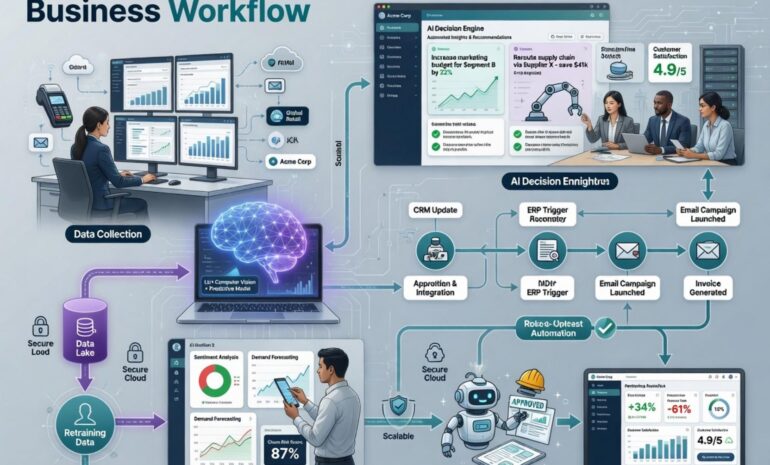
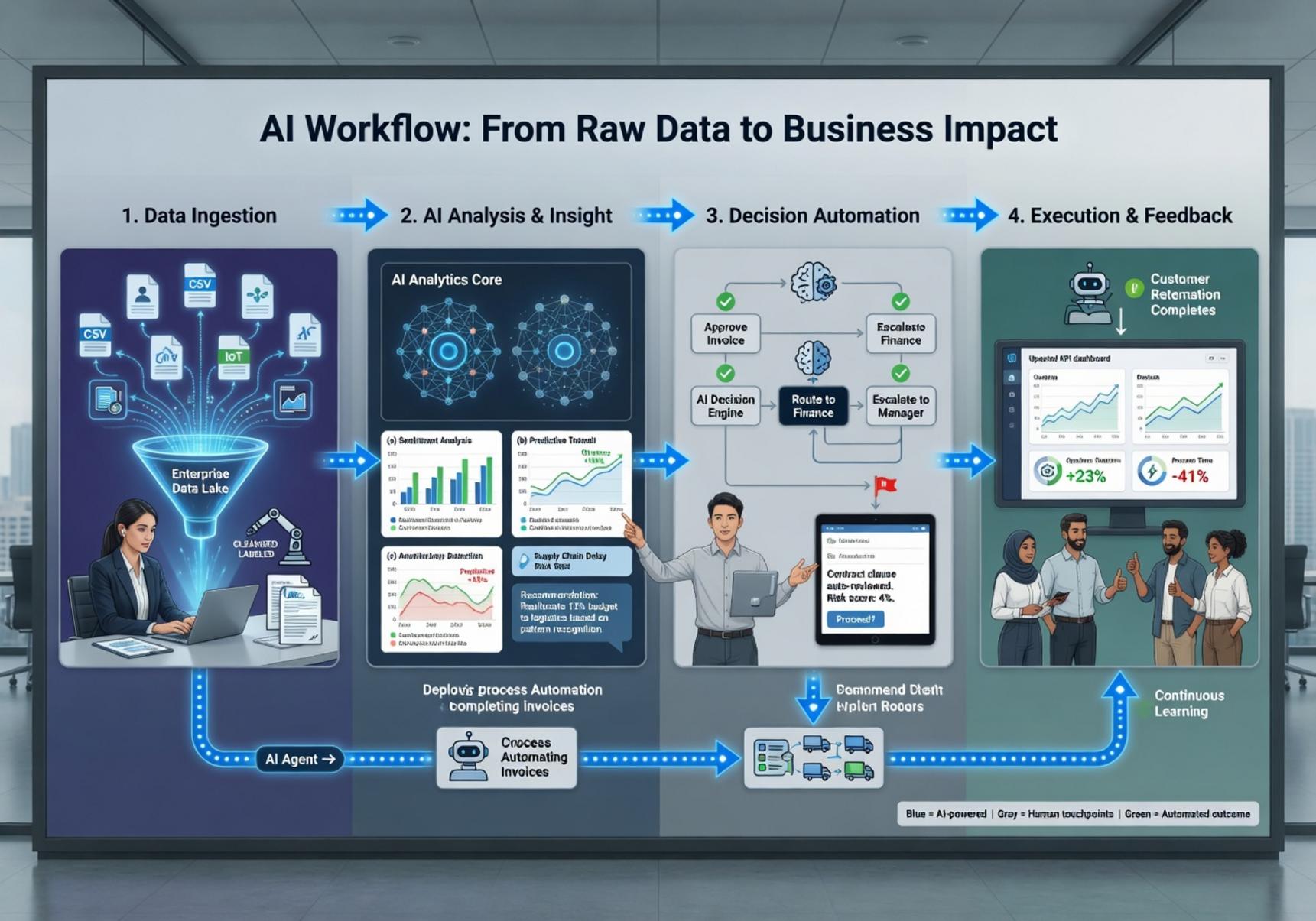
In today’s hyper‑connected marketplace, organizations that integrate AI workflows in business are seeing faster decision cycles, higher customer satisfaction, and a measurable lift in revenue. Meanwhile, leaders that embrace enterprise AI workflows, productivity with AI, business automation are not only cutting operational costs but also unlocking new sources of competitive advantage. This post walks you through a practical, step‑by‑step implementation plan that blends low‑code platforms, pre‑built models, and best‑in‑class governance, so you can replicate success without reinventing the wheel.
Step‑by‑Step Instructions
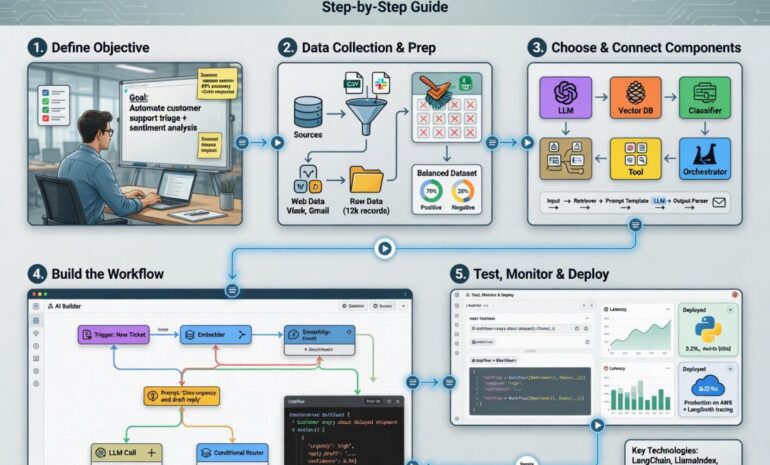
- Map the current process landscape. Begin by charting every manual touchpoint—data entry, approval loops, reporting, and customer outreach. Use a simple flow‑chart tool (e.g., Lucidchart) to visualize where latency spikes.
- Identify high‑impact automation candidates. Prioritize tasks that are repetitive, rule‑based, and generate large data volumes. Typical wins include invoice processing, lead scoring, and sentiment analysis of support tickets.
- Select the right AI services. For text‑heavy steps, consider large‑language models (LLMs) via APIs such as OpenAI or Anthropic. For image or video tasks, explore vision models from Google Cloud Vision or AWS Rekognition. Ensure each service offers RESTful endpoints to plug into workflow engines.
- Build the workflow with a no‑code orchestrator. Using a platform like n8n, drag‑and‑drop nodes that call your chosen AI APIs, add conditional branches, and route results to downstream systems (CRM, ERP, Slack). The visual editor lets you validate each step in real time.
- Incorporate data validation and fallback logic. AI predictions are probabilistic; embed confidence thresholds. If a model’s confidence falls below 80 %, trigger a human review node to maintain data integrity.
- Test in a sandbox environment. Run the end‑to‑end flow with a representative data set. Capture latency, error rates, and model drift. Adjust timeout settings and retry strategies until the workflow meets your Service Level Agreement (SLA).
- Deploy to production with monitoring. Enable logging, alerting, and performance dashboards (Grafana, Datadog). Set up automated retraining pipelines so the model evolves with fresh data, keeping the AI workflows in business ecosystem healthy.
- Gather feedback and iterate. After the first month, conduct stakeholder interviews and measure KPIs—time saved, error reduction, and user satisfaction. Use these insights to refine the workflow or extend automation to adjacent processes.
Tips for Maximizing Impact
- Start small, think big. A single automated invoice‑validation flow can prove ROI within weeks and pave the way for enterprise‑wide adoption.
- Leverage existing data warehouses. Feeding clean, well‑structured data into AI models improves accuracy and reduces the need for extensive feature engineering.
- Adopt a governance framework. Define ownership, auditing procedures, and compliance checkpoints—especially for GDPR or industry‑specific regulations.
- Enable human‑in‑the‑loop (HITL). Combining AI speed with human judgment maintains trust and catches edge‑case errors before they propagate.
- Document everything. Clear runbooks and version‑controlled workflow files make onboarding new team members effortless.
Alternative Methods
If a no‑code orchestrator doesn’t fit your tech stack, consider these options:
- Custom micro‑service architecture. Build lightweight Docker containers for each AI call and stitch them together with an API gateway (Kong, Traefik). This offers maximum flexibility but requires more dev resources.
- RPA‑centric platforms. Tools like UiPath or Automation Anywhere now embed AI skills directly, letting you automate UI interactions alongside cognitive capabilities.
- Serverless functions. Deploy model inference to AWS Lambda or Azure Functions for cost‑effective, on‑demand scaling, especially for bursty workloads.
Choose the approach that aligns with your organization’s maturity, security posture, and budget constraints.
Conclusion
By systematically embedding AI workflows in business, you create a living engine that continuously improves efficiency and decision quality. The same disciplined methodology—process mapping, smart service selection, low‑code orchestration, and rigorous monitoring—applies equally to scaling enterprise AI workflows, productivity with AI, business automation across the entire enterprise. When the loop closes between data, AI insight, and action, the organization transforms from reactive to predictive, and from siloed effort to cohesive, data‑driven performance. Start with one pilot, measure the gains, and let the momentum carry you toward a fully automated, AI‑augmented future.